TL;DR Summary
After 34 years of successful ERP implementations across 40+ countries, I thought I had enterprise software deployment figured out. Then I spent four months studying AI implementation frameworks and discovered something unsettling: everything I knew about enterprise software deployment was wrong when it comes to AI.
This realization hit me during a client conversation in early 2024. A manufacturing CEO asked me, "Craig, we've heard about AI transforming supply chains. Can you help us implement it like you did with our ERP system?" My confident "absolutely" quickly turned into uncomfortable silence as I realized I had no idea how to answer that question properly.
That conversation sparked a deep research commitment that's consumed the better part of 2024 and continues through 2025. Here's what I've learned - and why every ERP veteran needs to rethink their approach to AI.
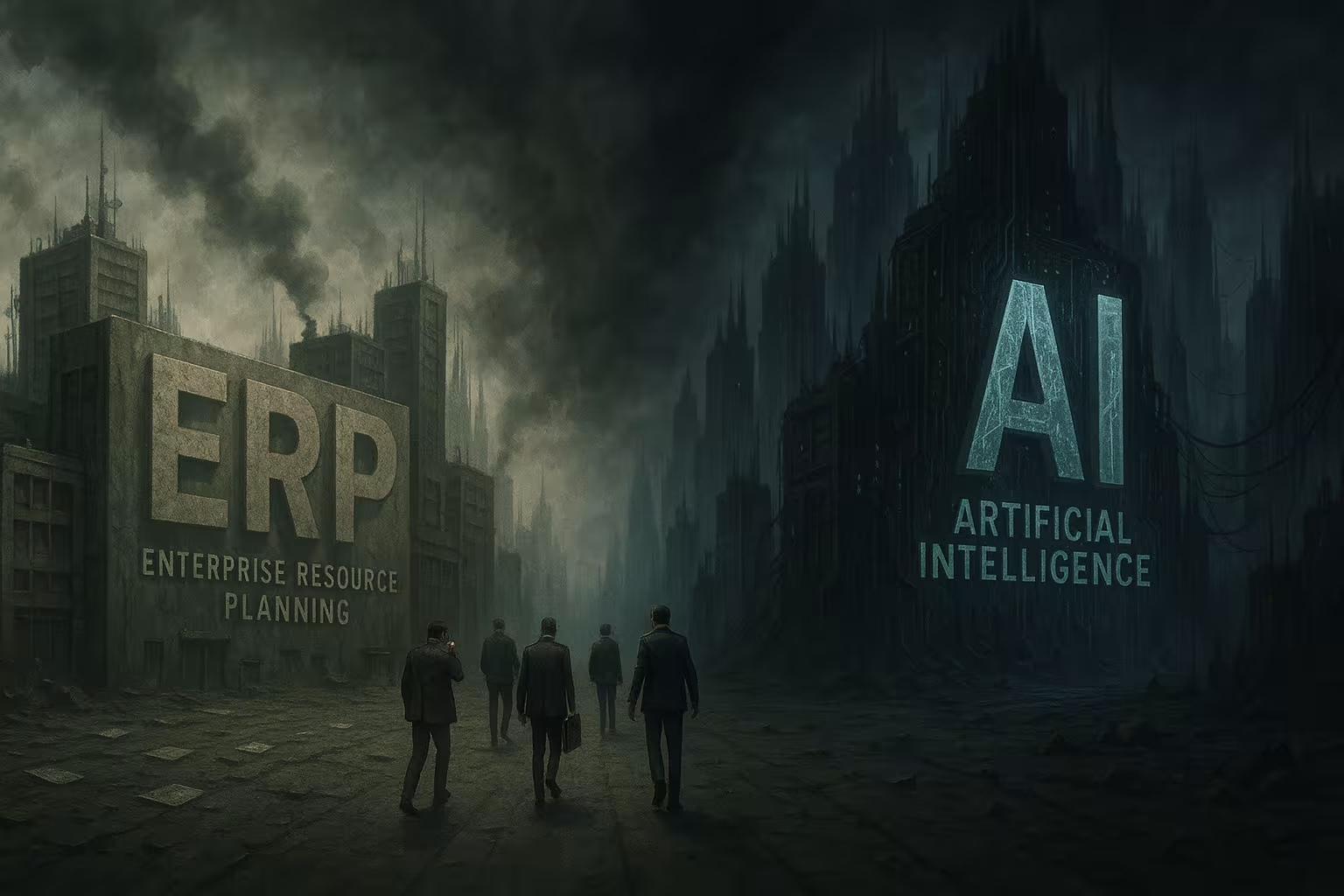
The Learning Journey: From Confidence to Confusion to Clarity
My clients weren't asking hypothetical questions about AI anymore. They were drowning in vendor pitches, consultant promises, and executive pressure to "do something with AI." Unlike our ERP discussions where I could draw from decades of battle-tested methodologies, AI conversations felt like navigating without a compass.
So I did what any good consultant does when facing knowledge gaps: I went back to school. My curriculum included Sol Rashidi's "Your AI Survival Guide," industry research from IBM and Oracle, manufacturing case studies, and countless hours studying implementation frameworks from successful AI deployments.
How Sol Rashidi's Work Became My North Star
Sol Rashidi stands out in the AI space because she's lived it. As the world's first Chief AI Officer (appointed in 2016) and someone who helped launch IBM Watson in 2011, she brings the kind of real-world implementation experience that's rare in the AI hype landscape.
"Success in AI isn't just about code or technology. It's about leading teams, aligning leadership, finding the right use cases, and persevering through hiccups." - Sol Rashidi
Her five-pillar framework (Strategy, Use-Case Selection, Preparation/Design, Solution Implementation, Long-term Maintenance) resonated because it felt familiar yet fundamentally different from ERP methodologies. The structure was there, but the execution principles were completely alien.
The Big Revelation: AI Is Not Software, It's a Living Entity
Here's my key takeaway from four months of intensive study: AI is akin to a living, breathing extension of the company's values, culture, and IP. It must be implemented and raised more like a young college graduate than like a piece of hardware or software.
This insight fundamentally changes everything about how we approach implementation.
ERP Mindset vs AI Reality
In ERP implementations, we configure systems to enforce standardized processes. We celebrate when the system forces compliance with best practices. We measure success by how well the software constrains user behavior to approved workflows.
AI operates in the opposite direction. It learns from your organization's actual behavior - the good, the bad, and the dysfunctional. It amplifies your culture, whether that culture promotes excellence or mediocrity. Unlike ERP, which can overcome poor processes through enforced workflows, AI will perpetuate and scale whatever it observes.
- ERP Implementation: Standardized processes, configuration-driven, predictable outcomes, go-live celebration
- AI Implementation: Adaptive learning, culture-dependent, evolving outcomes, continuous nurturing required
The statistics tell the story. ERP implementations have a 60%+ failure rate, but the reasons for failure are well-documented and largely preventable. AI projects face different challenges entirely - they can technically "work" while delivering business outcomes that nobody wanted.
What Actually Works: Framework Insights from the Trenches
Sol Rashidi's research reveals that 70% of AI project success comes from team dynamics, problem-solving approaches, and organizational readiness - not from the technology itself. This was my first major "aha moment" because it's the inverse of ERP projects, where technology selection and configuration drive most outcomes.
The "Crawl, Walk, Run" Philosophy
Unlike ERP implementations where you can often skip maturity levels through good consulting, AI maturity can't be rushed. Organizations must genuinely crawl before they walk. A company with poor data governance can't suddenly implement advanced AI analytics, no matter how much money they spend on consulting.
This means our traditional "big bang" ERP implementation strategies are not just ineffective for AI - they're counterproductive.
Manufacturing and Supply Chain Specifics
My manufacturing and supply chain clients face unique AI challenges. Their operations require real-time adaptation to changing conditions, but their regulatory environments demand process consistency. AI systems must learn to be flexible within rigid compliance frameworks.
The biggest pitfalls often come from organizational inertia and misaligned priorities, rather than software glitches.
Recent IBM research shows that 70% of Chief Supply Chain Officers report that generative AI has enhanced their responsiveness and communications with customers. But success requires treating AI as a team member that needs ongoing coaching, not a tool that gets deployed and forgotten.
My Emerging AI Implementation Methodology
Four months of study has led me to develop what I'm calling the "Nurturing Model" for AI implementations. It borrows structure from proven ERP methodologies while acknowledging AI's fundamentally different nature.
Assessment First - But Completely Different Criteria
ERP readiness assessments focus on process maturity, data quality, and organizational change capacity. AI readiness assessments must evaluate cultural openness to continuous learning, tolerance for ambiguous outcomes, and willingness to invest in long-term capability building.
The questions are different:
- Instead of "Do you have clean master data?" ask "Do you have a culture that learns from mistakes?"
- Instead of "Are executives committed to process change?" ask "Are executives prepared to guide an AI system like they would mentor a new employee?"
- Instead of "Can you handle a 12-month implementation?" ask "Can you commit to 3+ years of continuous development?"
Use Case Selection: Business Problem-First Always
Sol Rashidi emphasizes that successful AI implementations start with essential business priorities, not fascinating technology capabilities. This aligns with my ERP experience, but the execution is more nuanced.
AI use cases must be selected for their learning potential, not just their immediate ROI. The best first AI projects teach the organization how to work with AI while solving real business problems.
The Nurturing Model: Beyond Go-Live
ERP projects have a clear finish line - successful go-live and user adoption. AI projects have a beginning - successful initial deployment and the start of continuous learning.
This changes everything about project planning, budgeting, and success metrics.
What's Coming Next
This four-month journey has given me enough insights to be dangerous, but not enough to be truly expert. I'm continuing to study, test, and refine these frameworks with real client scenarios throughout 2025.
Future blog posts will dive deeper into specific aspects:
- AI readiness assessment frameworks for manufacturing companies
- Use case selection methodologies that actually work
- Change management strategies for continuous AI evolution
- Budget and timeline planning for AI "nurturing" models
I'm eager to learn from your experiences. If you're wrestling with AI implementation decisions, dealing with vendor promises that sound too good to be true, or trying to figure out how to apply your ERP experience to AI challenges, let's connect on LinkedIn. These conversations help refine my thinking and might help clarify yours.
The AI wave is real, and it's fundamentally different from any enterprise software wave we've experienced before. The good news? The implementation discipline we've developed through decades of ERP projects gives us a solid foundation. We just need to learn how to nurture instead of deploy, guide instead of configure, and evolve instead of celebrate go-live.
More insights coming soon. Stay tuned.